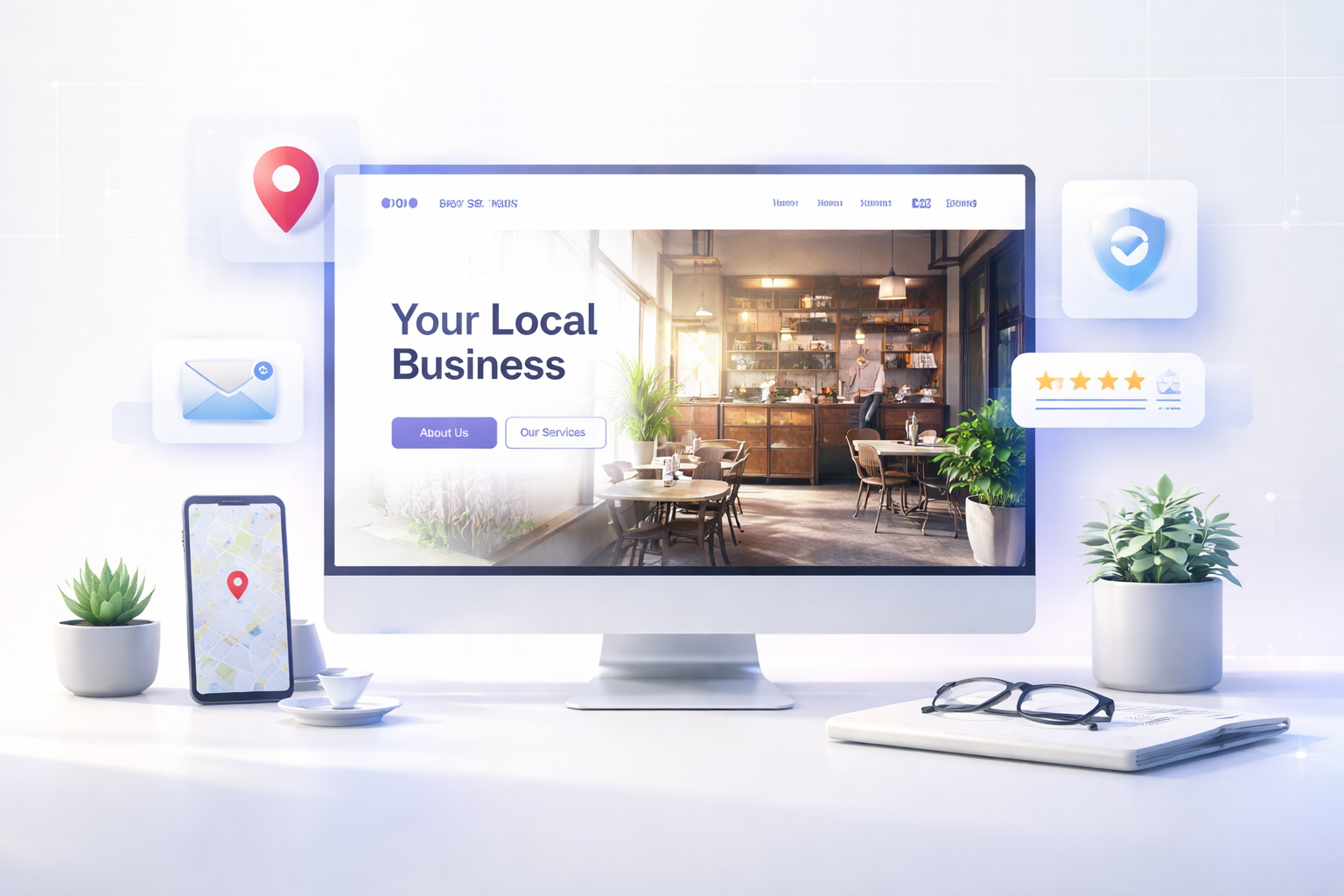
First impressions happen fast
For a local business, a website is not judged only as design. It is also judged as a signal of seriousness and reliability. Within the first few seconds, a visitor wants to understand what the business offers, where it is located, how to get in touch, and whether it feels worth trusting.
A website can be simple and still look professional as long as it is structured well and does not leave important questions unanswered.
Clarity beats unnecessary decoration
Many local websites try to look modern through effects, animations, or crowded visual blocks. In reality, what matters most is whether someone can quickly understand the offer and reach the contact details without friction.
- What the business does
- What products or services it offers
- Where it is located
- How it can be contacted
- Why it should feel trustworthy compared to alternatives
If those points are not clear immediately, the website loses impact even if it looks visually polished.
Essential information must be visible
A professional local website brings practical information forward. The visitor should not need to search for the basics.
- A visible phone number or email address
- The address or service area
- Business hours, if relevant
- A simple contact button or call to action
- A link to Google Maps or clear location guidance
These are not minor details. They often make the difference between a nice-looking website and a genuinely useful one.
Trust is built from concrete signals
A local business feels more professional when the website shows that it exists in a real and transparent way. That does not require exaggerated claims, only simple and credible trust signals.
- An About section or explanation of who is behind the business
- Real photos or relevant visuals
- Testimonials or social proof, when available
- Public pages such as Contact, Privacy Policy, or Terms
- Clear writing without artificial promises
Professionalism comes from coherence and transparency, not only aesthetics.
The offer should be presented simply
A local website loses a lot when it tries to say too much at once. A strong presentation clearly separates the core offer, the main advantages, and the next step a visitor can take.
Instead of overloading the homepage with too many ideas, a good site focuses on a simple structure: main message, benefits, examples or gallery, then contact.
Responsive and clean feels professional
For many local businesses, a large part of traffic comes from mobile devices. That means the mobile experience matters a lot. If buttons are hard to tap, text feels cramped, or key information is hidden, the sense of professionalism drops immediately.
A professional website is easy to use on mobile, fast, and free of unnecessary visual friction.
Conclusion
A local business website feels professional when it is clear, trustworthy, and practical. It does not need to impress with effects. It needs to communicate well, inspire trust, and help visitors quickly find what they came for. In most cases, well-executed simplicity looks more professional than visual excess.