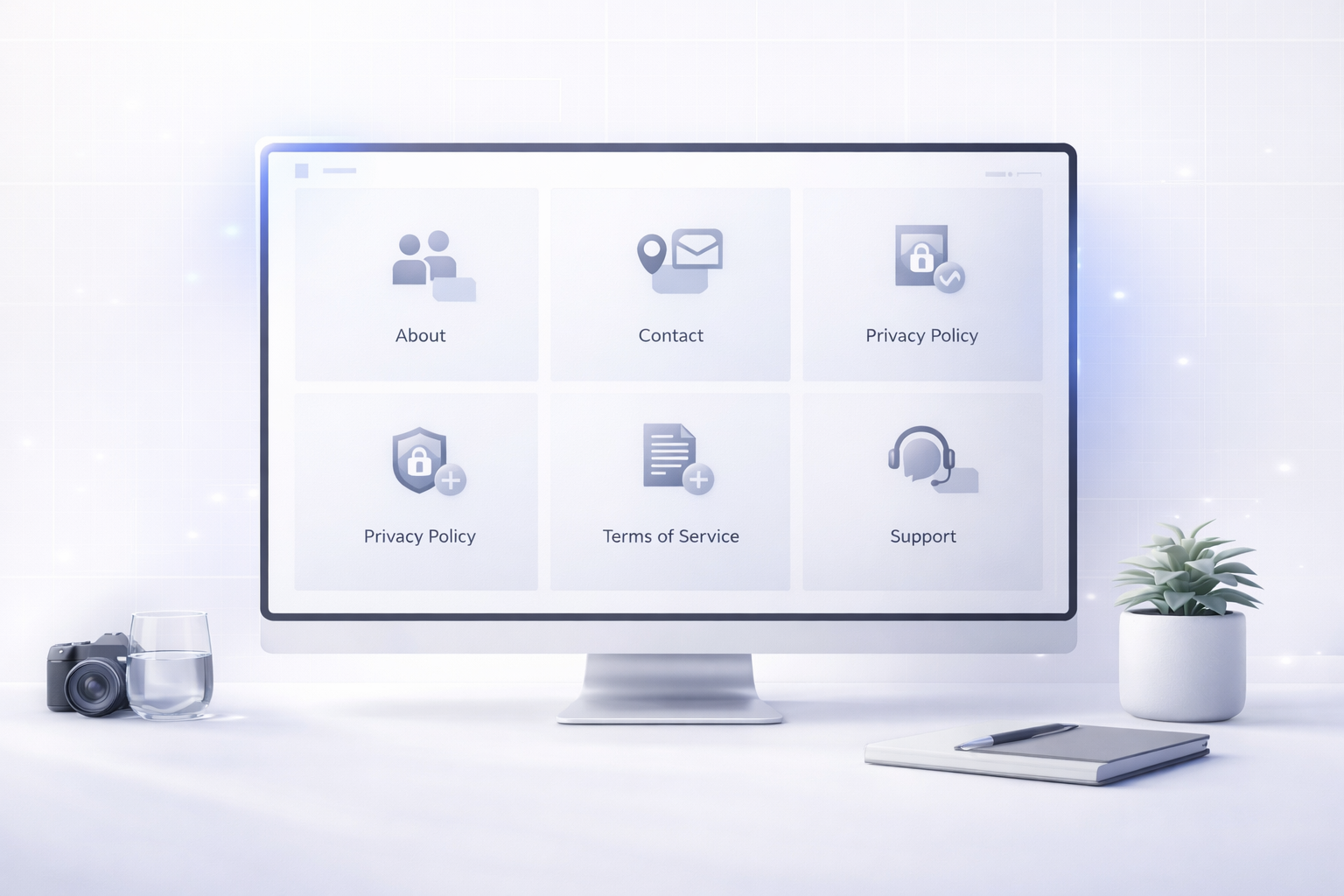
Legal pages are not a substitute for good content, but missing them is one of the fastest ways a site loses credibility.For a mobile products website, trust pages should answer simple questions: who is behind the site, how users can get in touch, what happens to data, and where support or account deletion information can be found.## Recommended minimum set - About - Contact - Privacy Policy - Terms of Service - Support - Account Deletion when products use accounts## What they must contain, not only exist as menu items - a clear public identity - a working email and real contact page - coherent explanations about cookies, analytics, and advertising - updated text that matches the real user flow of the products## Common mistakes - a generic privacy policy copied from somewhere else - a contact page without a public email - a support page that does not explain what users should include - terms that do not explain service limits or outbound links## Why this matters in review - it reduces the impression of an anonymous site - it shows public support and accountability processes - it clarifies the role of the website relative to Google Play products - it complements editorial content with trust signalsA serious site feels coherent as a whole. When trust pages are clear and connected to the rest of the content, the review becomes easier to pass.
Editorial
29 March 2026
anonym93 Studio
trust
legal
adsense
Trust pages that improve AdSense approval chances
About, Contact, Privacy Policy, Terms, and support pages built for clarity and credibility.
Continue reading
More articles from the archive
Editorial
What valuable content means for an apps and games website
Why listing pages are not enough and how to turn a portfolio into a genuinely useful editorial hub.
29 March 2026
Editorial
How to prepare a site for Google AdSense approval
A practical checklist for content depth, legal pages, navigation clarity, and trust signals.
29 March 2026
Editorial
How to Migrate from React SPA to Blade + Alpine.js: Real Case Study on anonym93.dev
I migrated anonym93.dev from a React SPA with 500KB JavaScript to Blade + Alpine.js with only 68KB CSS and zero application JS. Here's what I learned, what worked, and the Core Web Vitals scores before and after.
18 April 2026